
OP-ED: Cancel culture comes for Vice President Vance: why he’s likely resisting
Vice President J.D. Vance is receiving tremendous pressure to disavow journalist Tucker Carlson entirety, amid their longtime friendship. His response this week is very telling – and it’s an illustration of what political savviness can look like.
Opinion-analysis by Summer Lane | September 4, 2026
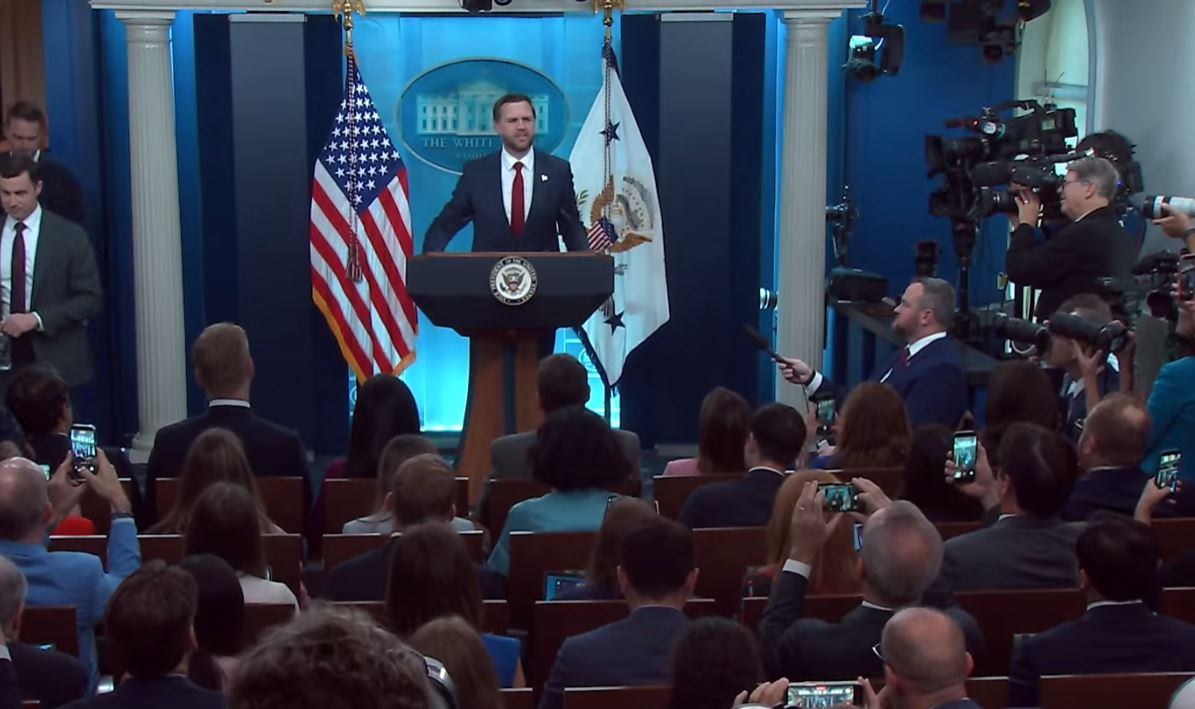
It was Thursday afternoon, and Vice President J.D. Vance was busy briefing the media on a wide variety of topics. One reporter’s question stood out: what did he have to say about those who might be “uneasy” with his friendship with Tucker Carlson, and did that mean he was avoiding key issues dividing the GOP that are linked to the influential journalist?
“I’m not avoiding addressing anything,” Vance responded coolly. “Everybody knows that Tucker Carlson and I are friends, and I think it’s very obvious that Tucker has said some things that I disagree with. He’s said some things about the President of the United States that I think are just wrong.”
He tempered his comment by pointing out that it was important to remain friends even with those you disagree with. “Tucker is a friend of mine – Tucker is a friend despite the fact that we disagree on a number of things, and I’m not going to play the game where I throw friends under the bus because I have political disagreements with them,” he continued.
He urged Americans to have open conversations about disagreements, noting, “…Because the whole Republic depends on people with different perspectives being able to talk to one another.”
The vice president’s answer was tame enough, and just a few years ago, would have been considered completely acceptable. But that hasn’t stopped the social media mob from pressuring Vance to completely disavow Carlson as a human being – something the vice president has conspicuously avoided, even as his boss, President Donald Trump, has repeatedly and publicly attacked Carlson.
What the influencers are saying
Online conservative influencers did a lot in 2024 to help President Trump get re-elected, and it’s safe to say that Tucker Carlson was one of the most powerful voices out there on the MAGA frontlines. From appearing at Trump rallies and having the president on his massively popular podcast (drumming up hundreds of millions of online impressions), Carlson was all-in on the Trump Train.
That all changed in February 2026, when the Trump administration took America to war with Iran. Carlson, who now owns his own network and podcast, has publicly criticized the war and taken a stance that is in direct opposition to the current White House.
Ever since, he has garnered considerable blowback from other influencers in the conservative sphere, and there has been intense pressure, at least toward Vice President Vance, to force him to sever ties with the controversial podcaster.
“Tucker Carlson has called for President Trump’s impeachment, and he’s called him the anti-Christ,” conservative influencer Catturd declared on X this week. “He’s doing everything in his power to get Democrats elected. There’s no grey area here.”
Political warmonger and Trump ally Laura Loomer suggested that Vance wasn’t loyal to the president in a scathing post on the social media platform, writing, “…I can’t imagine why anyone who is actually loyal to President Trump would want to be friends with Tucker Carlson. I’ve ended friendships over less.”
And, of course, Daily Wire commentator Ben Shapiro suggested that the real question was whether the vice president still sees Carlson as an integral part of the conservative movement. “So, the real question is that: does the VP still think that?” Shapiro fumed on X. “If so, why? Why, precisely, are Tucker Carlson’s views — El-Sayed as ‘America First,’ Trump as anti-Christ , feudalism as superior to our current system, propagandizing on behalf of shariah law and Russia, anti-Semitic conspiracism, etc. — a part of the conservative movement?”
Of course, Shapiro’s statements about Carlson are, in all fairness, very broad. Carlson, for questioning the Israeli government’s potential motivations within the American government system, has been blacklisted as an “anti-Semite.” It’s a label critics are eager to utilize, but Vance has neatly dodged it, and for good reason: it’s politically radioactive.
The controversy over the war with Iran – whether one supports it or not – is not going away anytime soon. Why it was started, how long it will last, and how glaringly antithetical it is to President Trump’s 2024 pro-peace campaign platform will remain a topic of debate for decades, if not centuries, to come.
The deeper issue here is why it is so important for conservatives to push Vance to not just acknowledge his disagreements with Carlson (something he has already done), but to force the vice president to publicly end his friendship with Carlson and specifically renounce the journalist on a human level.
President Trump’s thoughts on Carlson are no secret
For breaking with the president, Carlson has received the standard political attacks from President Trump, and this is to be expected. If someone punches at Trump, he punches back harder. That’s his style, and it’s part of why he has tremendous popularity with everyday Americans who understand the language of plain retaliation.
The president’s attacks on Carlson have been repeated and, notably, some of the harshest criticisms he’s ever dished out. In April, for example, President Trump called Carlson a “Hand Flailing Fool” who “couldn’t even finish College,” and recommended he see a “good psychiatrist.”
In late August, Trump took a swing at Carlson yet again, accusing him of being “totally irrelevant” and labeling him as “Low I.Q.”
“He could barely get out of College, and maybe he didn’t, but only really dumb people can’t make it through that wonderful four year time in life!” the president said.
It should be noted that two-thirds of President Trump’s 2024 voters did not have a college degree, according to Pew Research Center.
And, while the president has labeled Carlson as “irrelevant,” whether one loves him or hates him, the journalist is pulling millions of subscribers, and his high-profile interviews and conversations consistently get tremendous attention.
Importantly, Carlson caters directly to a demographic that Vice President J.D. Vance will need to court if he’s going to have a chance at winning in 2028: male voters.
Why Vance is being careful (so far)
Vice President Vance, if he wants to run for president in 2028, must walk a very difficult political line, one that balances the loyal MAGA voters who elected President Donald Trump and those who have shifted toward voices like Tucker Carlson in the media.
Vance will need both blocs to win, and he will particularly need the male vote – a demographic that the late, great Charlie Kirk worked hard to reach.
Carlson’s popularity among male listeners is significant, amounting to nearly 60 percent of his audience. It would be silly for Vance to fully condemn someone who holds influence over important voters.
When it comes to Vance, his friendship with Carlson and his refusal to cancel him is likely much deeper than pure moral conviction. It’s probably a hefty dose of political strategy. It’s also telling: his stance is so radically different than President Trump’s that it suggests, at least to the average observer, that Vance is going to try very hard to distinguish himself as a fully autonomous candidate apart from his tenure with the Trump administration.
It’s unclear how this will play out, but these small micro-decisions, while puzzling now, may later amount to the difference between a Vance presidency or something else altogether.