

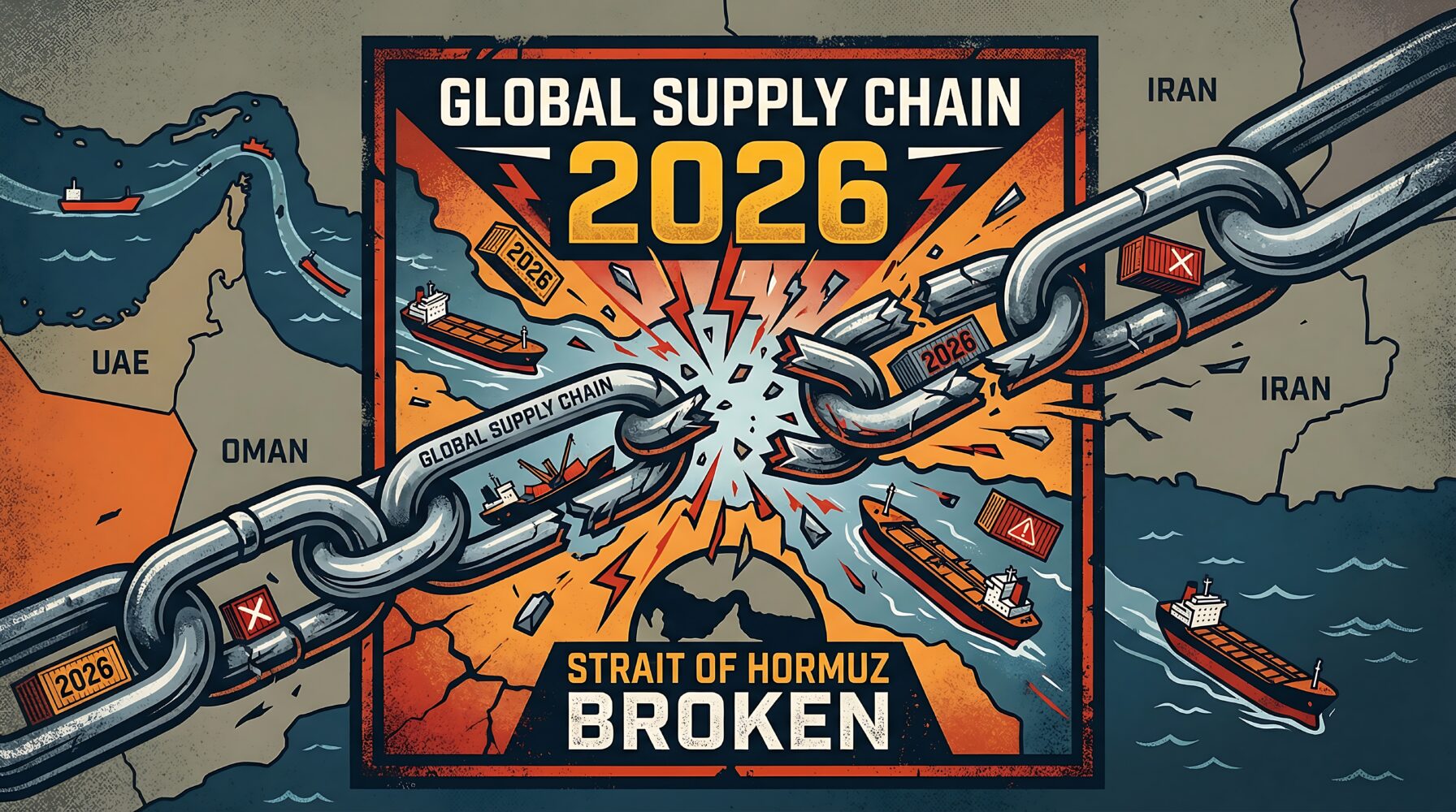
OPINION: A global supply crisis is looming – end the war NOW
The United States of America currently enjoys some insulation from the negative side effects of war with Iran, but make no mistake, those pain points will come to our shores soon if the conflict is not ended soon
Opinion-editorial by Summer Lane | April 24, 2026
During the Covid pandemic, Americans mobbed Costco for toilet paper and feverishly stalked every online retailer known to man for hand sanitizer. Supply chain shortages plagued the nation, ranging from basic cleaning supplies and baby formulas to integral Chinese-sourced microchips that caused a massive backup in automobile production.
Covid was the first domestic supply crisis in America in quite some time, and it rightfully frightened many people. Between the tyrannical lockdown measures that seemed to stretch on forever (hello, California), or unfair mask mandates in public schools, America, for a time, became a blur of dystopian government overreach as supply chains failed and fear reigned.
Today, America faces another conflict, this one far less medical, but far more dangerous in many ways: war in Iran.
Launched on February 28, the war has been fraught with uncertainty. Iranian Navy and Air Force power might be seriously degraded, but two things remain clear: Iran does have key leverage over the Strait of Hormuz, and even if their military forces are degraded, they are still willing to fight.
Unlike the U.S. military’s dazzling smash-and-grab mission into Venezuela in early January, which lasted a mere handful of hours, taking down Iran, an ancient civilization, and implementing regime change in that chaotic and difficult region of the world has not been nearly as simple as some may have thought.
On Friday, the White House confirmed that Special Envoy Steve Witkoff and Jared Kushner would be flying to Pakistan on Saturday for possible talks with Iran through Pakistani mediators.
It’s unclear what will happen next. Iran has suffered internal anarchy, following U.S. and Israeli attacks on the region that killed multiple layers of IRGC leadership, making negotiations difficult on America’s end.
“Their Navy’s gone, their Air Force is gone, their anti-aircraft is all gone, it’s all gone,” President Trump said in late March.
He continued, “Their radar’s all gone. Their leaders are all gone. The next set of leaders are all gone. And the next set of leaders are mostly gone. And now, nobody wants to be a leader there anymore. We’re having a hard time. We want to talk to them, and there’s nobody to talk to! …And you know what? We like it that way.”
For all of President Trump’s masterful bravado, the lack of surviving Iranian leadership has not been a good thing. It has slowed communications and negotiations and contributed to internal power battles in the region.
President Trump said on Truth Social this week, “Iran is having a very hard time figuring out who their leader is! They just don’t know! The infighting is between the ‘Hardliners,’ who have been losing BADLY on the battlefield, and the ‘Moderates,’ who are not very moderate at all (but gaining respect!), is CRAZY!”
He’s alluding here to a power vacuum in the region. Without leadership, there is chaos, and as far as Iran goes, the U.S. needs a unified response to get a unified agreement on a peace resolution that actually has teeth.
But every day peace is not achieved, and every day the Strait of Hormuz is unopened, the world economy destabilizes a little more, and supply chain problems become increasingly worse.
Oil and gas (the usual suspects)
The Strait of Hormuz allows the free flow of 20-25 percent of the world’s oil and gas supply, making it a critical epicenter for all of Europe. The closure of the Strait (56 days to date) has already affected countries like Kosovo, Sweden, France, Germany, and Belgium, for example, with fuel prices rising up to 26 percent.
And yes, while Americans do not depend on the oil that flows through the Strait of Hormuz, the prices and shortages in Europe do affect them eventually – there are only so many barrels in the U.S. Strategic Petroleum Reserve, and although the U.S. now has access to Venezuelan crude, it takes time to ship it here and refine it.
According to a CNBC All-America Economic Survey, 60 percent of Americans have cut out entertainment like eating out or going to the movies. Why? To save money, due to the burden of rising fuel prices (spiking up to 30 percent, per AAA), which is driving up the cost of everything else.
Fertilizer and food
Another extremely key factor to consider here is the fact that the Strait of Hormuz is also a critical shipping channel for up to one-third of the global trade in fertilizer, according to the United Nations.
Simply put, fertilizer is used to grow crops, and without it, there will be a huge disruption in the growing season (consider that the conflict with Iran happened on the cusp of spring).
From the UN:
“The timing is especially concerning, coinciding with key crop planting windows. Farmers facing higher costs and uncertain access to fertilizers may reduce input use, plant less or shift crops – decisions that could lower yields and tighten food supplies in the months ahead.”
The possibility of a global food shortage (at least in the European and Eastern spheres) is extremely real. As it is, crop-planting has already been disrupted, so there will be a delayed but painful effect even if the war were to end right now.
A shortage of this sheer size and volume would drive prices up for imported goods to America, and it would likely force producers to focus wholly on domestic products to bridge the gap in supply. Either way, yield will be reduced, and the price will be higher.
Plastic and chemical shortages, jet fuel shortages, and decreased flights
An analysis from the Atlantic Council suggested that the protracted closure of the Strait of Hormuz could reduce up to 24 percent of seaborne naphtha, a petrochemical input that is heavily produced in the Middle East, along with other key petrochemicals.
It also noted that these shortages of key plastic and chemicals, sparked by the Strait’s closure, would benefit China by consolidating its supply chains and increasing its profitability in supplying those key chemicals instead.
In Europe, the fuel crisis has led to a looming jet fuel shortage, leading to skyrocketing flight costs. Europe receives roughly 75 percent of its jet fuel from the Middle East, according to CNBC, and as the Strait stays shut, European flight carriers have begun to reduce their flights to conserve supplies.
The world may seem big, but when it comes to supply chains, it’s actually quite small, and what is hurting Europe and Asia right now will soon acutely hurt the U.S. economy – and in many ways, Americans can already feel the pinch.
Wrap it up NOW
The best possible outcome for this looming crisis is for the United States and Iran to immediately cease hostilities, to agree on a peace outcome, and to end the war. Further escalation in the Middle East will only prolong the closure of the Strait of Hormuz and accelerate the already fragile supply chain structure worldwide.
“The United States can easily exit its direct military involvement in this conflict by treating any drawdown as a deliberate, conditions-based success rather than a retreat,” observed Ret. Gen. Michael Flynn on X.
He added, “This is not wishful thinking. This idea aligns with how great powers have historically managed limited wars when core objectives are met or costs outweigh benefits.”
Americans are ready for this war to be over, and so is the rest of the world. President Trump and his peace delegation must find a way to bring this fight to an immediate and long-term close.
Photo: Adobe Stock