
Separation of church and state is a lie. Zohran Mamdani just proved it
Mayor Mamdani openly preaches a gospel of communism mixed with religious ideology, challenging leftists’ oft-touted belief in separation of church and state
Opinion-editorial by Summer Lane | February 6, 2026
During remarks this week, New York City Mayor Zohran Mamdani delivered an ideologically fueled speech urging Americans to look to both Buddhism and the Islamic Prophet Muhammad when it comes to immigration policies.
“I think of the freedom from suffering that Buddhism teaches us is only possible if we remove the three poisons of desire, hatred, and ignorance from our daily lives,” he said. “We need not accept suffering as unchangeable; we need not treat hatred as the natural state. We have the power to set ourselves free.”
Mamdani then pivoted to his own faith, Islam, which he said was “a religion built upon a narrative of migration.”
“The story of the Hijrah reminds us that Prophet Muhammad…was a stranger too, who fled Mecca and was welcomed in Medina,” he said. “…If faith offers us the moral compass to stand alongside the stranger, government can provide the resources. Let us create a new expectation of city hall, where power is wielded to love, to embrace, and to protect.”
Mamdani, for all his smooth talk and stated devotion to embracing the illegal migrant, has proven one thing, at least: there is no such thing as separation of church and state, or even the illusion of it.
The lie of separation of church and state
For years, radical leftists have proclaimed loudly and proudly that there must be a separation between church and state, or else religious tyranny will fall upon the nation.
The phrase “separation of church and state” is erroneously foisted about in common debate and in political arenas as if it is the law of the land, but it is not.
The phrase appears nowhere in America’s founding documents. In fact, the phraseology arises from a letter penned by Founding Father and former President Thomas Jefferson. In 1802, he wrote to the Danbury Baptist Association in Connecticut. In this letter, he wrote:
“Believing with you that religion is a matter which lies solely between Man & his God, that he owes account to none other for his faith or his worship, that the legitimate powers of government reach actions only, & not opinions, I contemplate with sovereign reverence that act of the whole American people which declared that their legislature should ‘make no law respecting an establishment of religion, or prohibiting the free exercise thereof,’ thus building a wall of separation between Church & State.”
In context, Jefferson was clearly referring to the importance of protecting First Amendment rights and Americans’ ability to worship freely without impediment from the federal government.
This was not an endorsement of secularism, nor was it an official government pronouncement of building a “wall” between religion and government. In fact, the Founding Fathers hoped that Christianity and the values of this moral belief system would directly inform the men and women leading the very young and very volatile United States.
“Let us with caution indulge the supposition, that morality can be maintained without religion,” said former President George Washington in his farewell address in 1796. “Whatever may be conceded to the influence of refined education on minds of peculiar structure, reason and experience both forbid us to expect that National morality can prevail in exclusion of religious principle.”
Here, Washington made an integral point: morality and the overall goodness of the populace cannot be maintained without the influence of some religious belief system.
The only question is, what religion was he referring to? In his day, this would have been Christianity. While President Washington was an openly religious man, many other founders were not. And yet, all of them were influenced profoundly by the Christian-Judeo belief system of the era, which in turn influenced their thinking of definitions of justice, morality, and government.
The founders shaped the United States and its Constitution based upon the Biblical belief that man is sinful and corruptible, hence why government will always turn tyrannical without moral and good people to rein it in.
This foundational belief is what has made America great. Christianity shaped the West and made it the greatest nation to ever exist. Now, the U.S. is facing an ideological and religious war on its on own soil. The victor in this battle will determine the future of the country.
Subjective religious influences
What is the reigning worldview and religious influence in America today? Is it Christianity? Some may argue that it is. Is it secularism? In the federal apparatus, perhaps. But the reality remains: religion, in whatever form, shapes every aspect of society.
Secularism purports to be a lack of religion, but indeed, it is simply the elevation of naturalistic functions, a religious arm, if you will, of science, order, and observation. Humanism is the worship of self, the worship of human reason. Communism is the religion of the state – the promotion of the god of government, demanding worship through complete subjugation. Islam is the worship of Allah, influenced by the Prophet Muhammad.
When politicians like Mayor Mamdani push communism and Islam at the same time, understand this: this is a religious battle, and despite leftists’ creed that religion and government cannot cross, it is. Every day. It always has.
Mamdani is openly advocating for his own belief system and his own religion in his official capacity as a political leader. He’s not the only one. It happens all the time, and it will continue to happen as long as there is religious freedom in this country. This is not a bad thing, necessarily, but it becomes a bad thing when Christians falsely believe that they cannot advocate for their own beliefs and values because a supposed wall of separation between church and state exists to stop them.
Christianity and its influence on the West are being explicitly attacked every moment, whether it’s in the form of militant transgenderism and abortion (forms of hedonistic paganism) or the explicit promotion of Islam in New York.
The answer is not to declare “separation of church and state” and walk away. The answer is to defend the Christian roots and values that made this nation great. There will always be a religion that dominates the United States, whether one likes it or not.
What will that religion be? A religion of self-worship and secularism?
Or will it be Islam, with its violent undertones and dangerous rhetoric?
The ideological battle lines have never been clearer. The separation of church and state is a lie. It always has been, and it always will be. The question is, can Christianity and its values endure in the West? For the sake of freedom, it must.
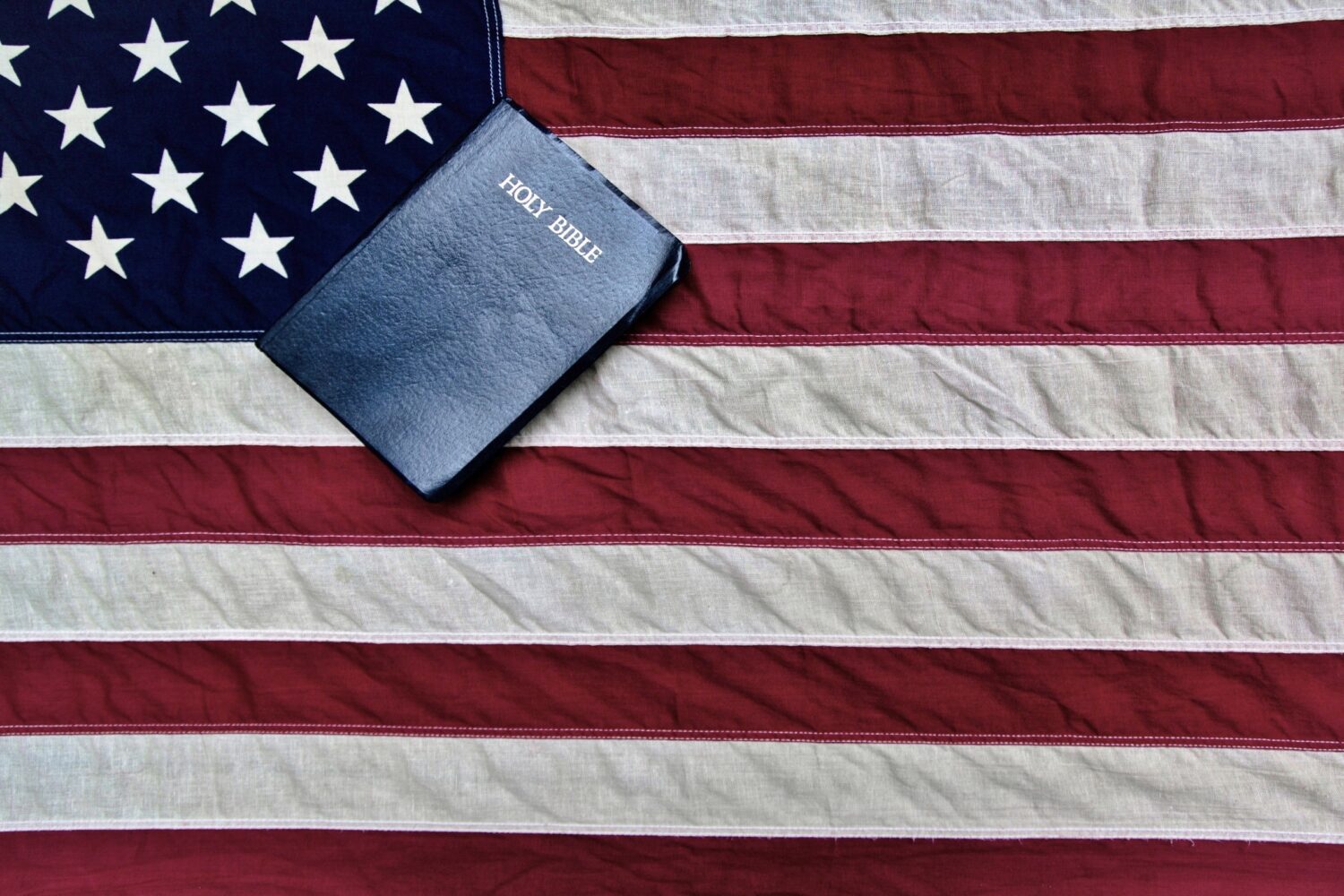
Photo: Adobe Stock