

The X-Report—Why did the government plant 20,000 trees in rural Oklahoma?
What is going on in the woods of Oklahoma?
The X-Report column | By Easton Martin | August 28, 2025
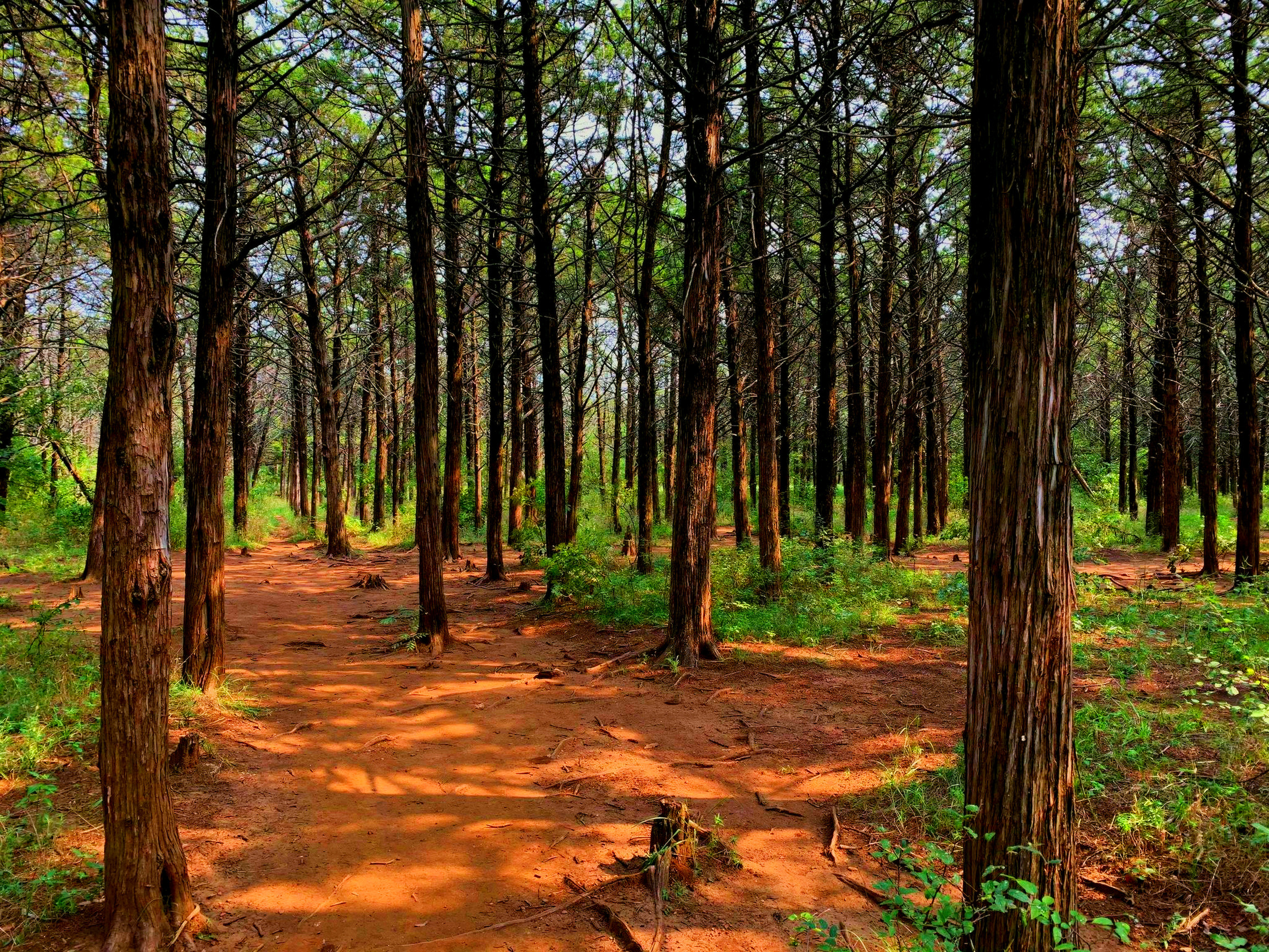
Southwest Oklahoma’s Wichita Mountains, there lies 16 acres of red cedar trees, all planted perfectly parallel to each other. Every tree is six feet from its neighbor, and every row lines up as if traced with a ruler. Step inside, and you find yourself in a place where the natural disorder of a forest is replaced by rigid, man-made order.
The Parallel Forest was not meant to be strange. It was planted during the 1930s as part of President Franklin D. Roosevelt’s Prairie States Forestry Project, a massive effort to counter the devastation of the Dust Bowl. During those years, storms of windblown soil blackened skies, destroyed farmland, and drove families from their homes. To combat the erosion, the government set about planting thousands of miles of trees to act as windbreaks. In the Wichita Mountains, crews from the Civilian Conservation Corps laid down more than 20,000 red cedar saplings in a perfectly measured grid. The purpose was scientific and practical: the trees would grow straight, stand tall, and help anchor the fragile soil.Nearly a century later, the forest still stands. And while it achieved its original purpose, it has also become something else entirely.
Locals and visitors describe the Parallel Forest as unnerving, its symmetry is disorienting and feels endless, like you could walk forever and never reach the other side. Shadows cast by the cedars fall in sharp patterns, and the silence carries differently here, amplifying the sense that you are being watched.As with any place that feels “off,” legends quickly grew. Some say the forest is haunted, with reports of ghostly figures moving between the trees or the sound of drums beating in the distance. Others speak of a stone circle hidden within the grove, sometimes referred to as an altar, where strange rituals are said to have taken place. Paranormal enthusiasts claim the site has unusual energy, while skeptics argue that the eerie atmosphere is more about human psychology than spirits.
The Parallel Forest has become a destination for ghost hunters, folklore seekers, and curious travelers. Some treat it as a historical site, a reminder of how the Dust Bowl reshaped the landscape. Others go looking for shadows, stories, or the thrill of being unsettled in a place that feels both natural and unnatural at once. There are many locations in our country, places of manmade origin and places of natural origin, which harbor tales of supernatural activity, and some of these places have more credible stories than others.
What is so fascinating about the parallel forest is the combination of the government’s involvement, and the subsequent legends which have developed over the years. What makes the Parallel Forest worth talking about is not only its history, but the way people have responded to it. Born out of crisis and necessity, it has evolved into one of Oklahoma’s strangest landmarks. Its rows of cedars stand as proof that when humans impose order on the land, the results can take on a life of their own.