

Securing the Nuclear Supply Chain: How a Texas Startup is Revolutionizing America’s Nuclear Future
By Easton Martin | August 26, 2026
An American nuclear technology startup has made a significant breakthrough in the production of high-assay low-enriched uranium. Actinide, a North-Texas based startup, announced Wednesday that it has become the first startup in history to enrich natural uranium into the HALEU (High-assay low-enriched uranium) range.
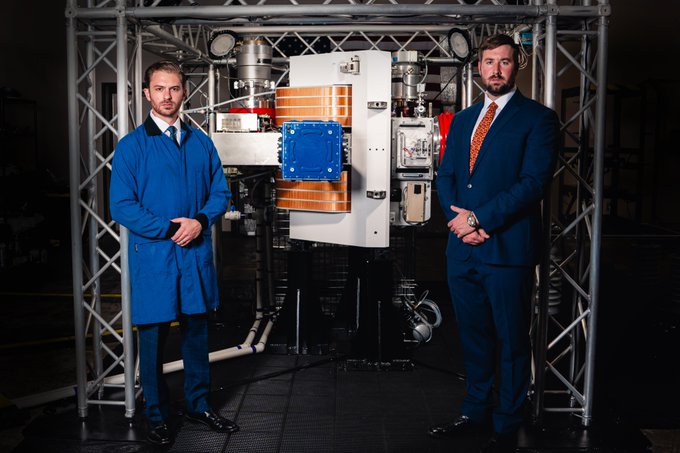
What makes this achievement particularly notable is because Actinide accomplished it using a modernized calutron rather than relying on the massive centrifuge facilities typically associated with uranium enrichment. The company says its first-generation machine produced research quantities of HALEU at 15.38 percent enrichment.
Traditional enrichment methods use centrifuges to separate uranium isotopes after converting the material into a gas. Those facilities require enormous investments and can take years to construct. Instead, Actinide uses electromagnetic isotope separation to sort atoms by mass within a magnetic field.
The technology also demonstrates an unusual degree of flexibility for an isotope separation system. Just weeks before producing HALEU the same first-generation calutron was producing enriched ytterbium-176 for Actinide’s commercial customer Oklo Isotopes.
Robert Mendelsohn who serves as Actinide’s co-founder and chief technology officer described the significance of the demonstration:
“This demonstration is a testament to the power and flexibility of our technology. A centrifuge plant does one thing, costs billions, and takes years to stand up. Our machines cost a few hundred thousand dollars, produce material within months, deploy anywhere, and are able to be reconfigured in a matter of days to separate various isotopes as they are needed.”
The company’s approach could address one of the biggest weaknesses in America’s nuclear supply chain. The Department of Energy has previously acknowledged that domestic capacity for producing HALEU remains extremely limited. DOE has described that shortage as a significant obstacle to developing and deploying advanced nuclear reactors.
HALEU is especially important because many advanced reactor designs require uranium enriched beyond the conventional five percent limit used by today’s commercial reactors. Actinide’s demonstration therefore arrives as American nuclear companies are attempting to develop a new generation of reactors that could provide reliable energy while using more efficient fuel designs.
The supply problem also carries significant national security implications. For years American nuclear development has depended heavily on foreign enrichment services. Actinide reports that 77 percent of enrichment services purchased by American civilian reactor owners in 2025 came from foreign sources.
Russia has been particularly important to the HALEU market. During a 2023 Senate Energy and Natural Resources Committee hearing Senator Joe Manchin warned that Russia had become the only commercial supplier of HALEU available for many advanced nuclear applications.
“Putin has a stranglehold on the nuclear fuel supply chain. Currently, Russia is the only commercial supplier of HALEU, the fuel used for our DoD micro-reactor project, DOE Advanced Reactor Demonstration Projects, and many other advanced nuclear technologies.”
Manchin argued that the United States needed to rebuild domestic uranium conversion and enrichment capabilities rather than remain dependent upon foreign suppliers.
Actinide’s approach could provide another path toward that goal. The company’s machines are designed around electromagnetic isotope separation and can be configured for different isotopes instead of being dedicated to a single enrichment process. Its second-generation Fortitude machine is currently under development and the company estimates that one machine could eventually provide roughly half the isotope-separation capacity of the federal government’s current electromagnetic fleet.
That flexibility could extend well beyond nuclear fuel. Actinide says its technology is intended to support applications involving medicine, defense, energy, semiconductors and quantum systems.
The company has already demonstrated that its machines can move between different applications. Producing medical isotopes and then producing HALEU with the same basic technology suggests that isotope separation could become a more adaptable form of American manufacturing rather than a collection of massive specialized facilities.
America has spent decades allowing critical manufacturing capabilities to move overseas. Nuclear technology demonstrates the consequences of that dependence particularly clearly because energy production, medicine, advanced computing and national defense all depend upon access to specialized materials.
Actinide’s achievement offers an encouraging alternative. A young American company has demonstrated that sophisticated isotope separation can be pursued with comparatively compact equipment and domestic engineering rather than depending entirely on enormous foreign-linked supply chains.
Interest in nuclear research is surging across the board. At the same time, the Department of Energy’s National Reactor Innovation Center selected today a new cohort for its Nuclear Energy Launch Pad initiative, a program designed to fast-track advanced reactor development. We are witnessing the early stages of a true American nuclear energy renaissance.