

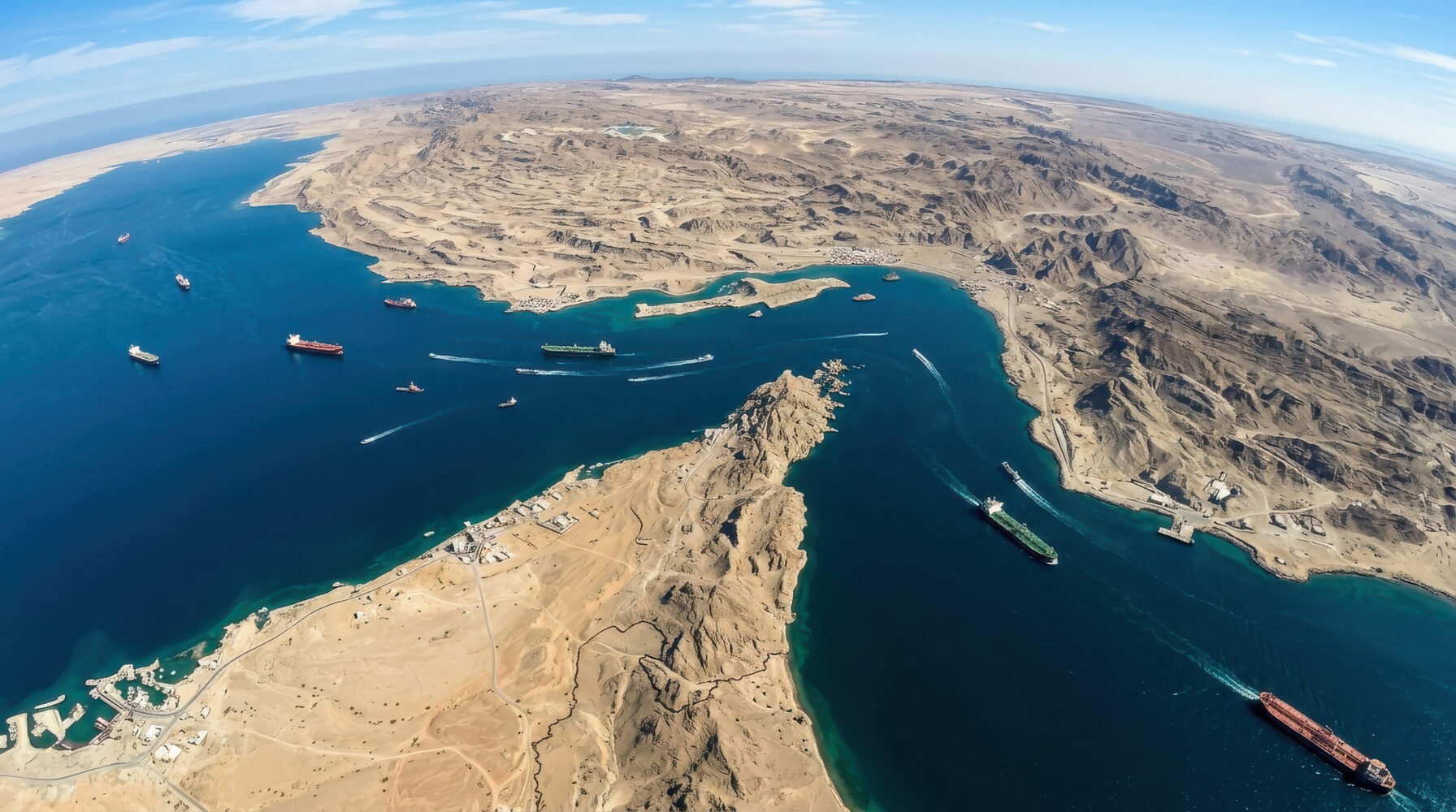
WHAT IF: Could the Strait of Hormuz really become a U.S. territory?
President Donald Trump recently suggested in a somewhat humorous comment that the Strait of Hormuz could become a U.S. territory. Would such a thing be possible? How does this comment factor into the 60-day deadline to establish a broader peace deal with Iran?
Analysis by Summer Lane | August 17, 2026
What would it take to make the Strait of Hormuz a U.S. territory? Would it even be possible?
The shipping corridor in the Middle East, responsible for the flow of about 20 percent of the world’s energy before the start of the U.S. war against Iran, has become the focal point for the entire conflict. Without the free flow of energy through the channel, the world’s oil and energy markets have been rocked – and it has introduced a threat that was previously unthinkable: the ability for Iran to inflict economic pressure on international markets.
“Pretty soon I’ll be declaring the Hormuz Strait a territory of the United States,” President Trump quipped last week, during a speech in New York.
His comment was delivered with a small smile, suggesting a bit of sarcasm. Is the president serious? It seems unlikely, but it’s hard to say – his negotiating style with Iran has been kinetic and adaptive. This comment is likely little more than a well-placed verbal jab at the enemy, but it does elicit questions about the future of the conflict overseas.
A 60-day marker
Monday marked the 60-day deadline in the memorandum of understanding that the U.S. and Iran inked in June. By today, many expected the two nations to have reached a broader peace agreement. That hasn’t happened.
There have been numerous clashes and conflicts that have arisen in the past 60 days, as the U.S. and Iran have swung wildly between a heated stalemate and an explosive back-and-forth.
As reported by LindellTV, President Trump recently told a Fox News reporter during a phone interview that he wasn’t “in a hurry” to reach a deal with Iran, but simultaneously threatened to “bomb the sh** out of Oman” should they interfere with negotiations.
His comments about Oman were sparked as reports have arisen that the Middle Eastern country has quietly been having discussions with Iran about reopening the Strait of Hormuz to commercial shipping.
Currently, the strait is only semi-open: the U.S. Navy is enforcing a strong blockade in the channel that is keeping ships from transiting to or from Iranian ports. Still, shipping traffic has remained tenuous and sparse. According to data from Kpler, only three ships transited the strait on Sunday – compared to the pre-war level of roughly 130 vessels daily.
How long can the strait remain closed before long-term damage is done to the oil and gas markets? It’s unclear.
U.S. Treasury Secretary Scott Bessent recently remarked that in the future, the Strait of Hormuz would be irrelevant because most of the oil would eventually be transported via underground pipelines.
However, the future is not yet here. Therefore, the Strait of Hormuz remains painfully relevant.
What Iran is reportedly saying about the Strait of Hormuz
On the heels of President Trump’s mostly sarcastic comment about making the strait a U.S. territory, Iran has reacted as one might expect: with hostility. “The Strait of Hormuz has been Iranian, is Iranian, and will remain Iranian; this strait will only be closed and opened under Iran’s command, and as long as you do not accept the reality of defeat and cease your fanciful delusions, Iran will continue to enforce the blockade,” said Iranian Deputy Foreign Minister Kazem Gharibabadi, via Al Jazeera.
Territorial claims on the Strait of Hormuz
The meat and potatoes of the matter come down to this: the Strait of Hormuz is an international waterway, and while many may argue that international law is purely theoretical, in this case, the power struggle over the shipping route is extremely real.
Iran claims to have authority over the strait, and yet the U.S. is pushing back on that claim by enforcing a Navy blockade. This may come down to pure wartime conquest. Claiming the Strait of Hormuz as a U.S. territory is likely not going to happen, but whoever is able to reopen the strait for business will be viewed as the victor in this conflict.
It is key, then, that Oman and Iran do not reopen the Strait of Hormuz without the U.S.’s involvement – hence President Trump’s strong warning on Monday toward Oman. Such a move cannot be allowed.
It would be an unfortunate end result, indeed, if the Strait of Hormuz requires policing by the U.S. military from here on out just to keep the channel open. Barring a rapid declaration of victory and a withdrawal from the region, it’s hard to see how the U.S. can simply walk away from the region and leave the strait in the shadow of Iran’s newly discovered economic power.
The Strait of Hormuz may never be an official U.S. territory – but it sure might feel like it.
Photo: Adobe Stock




![Washington DC, District of Columbia, United States of America [ US White House, lawn and garden behind the fence, tourist visitors in the street ]](https://lindelltv.com/wp-content/uploads/2026/10/AdobeStock_316724535-1-236x133.jpeg)